
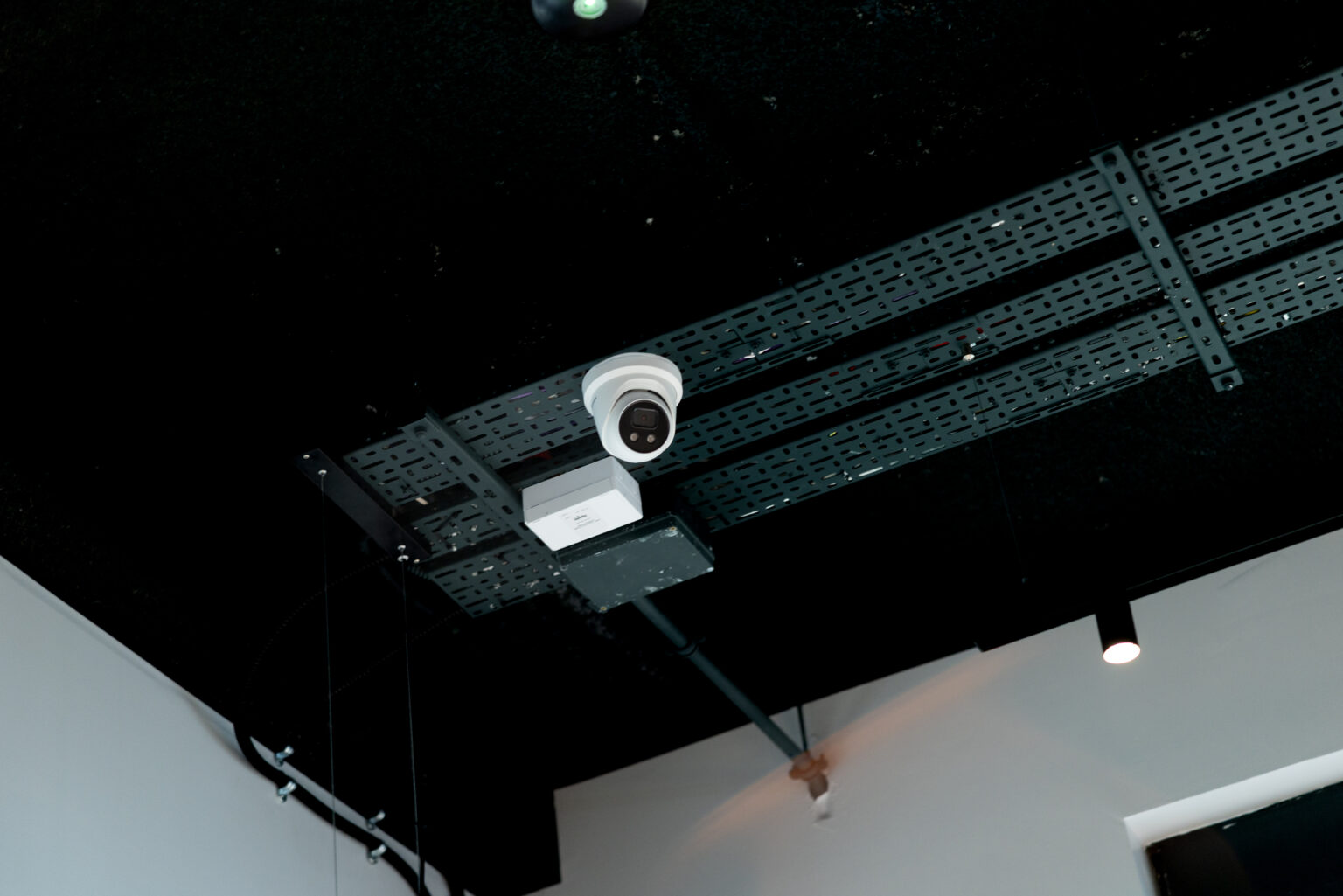
Commercial CCTV monitoring: who is actually monitoring your cameras?
Most CCTV records. It is not monitored. The difference decides whether an incident is something you interrupt at the time or something you review the next morning, and it is the whole reason monitored CCTV exists. Written for the person responsible for a commercial premises, this covers how it works, what it costs, and what your business is responsible for once a camera records someone.
What monitored CCTV actually means
A recorded system stores footage on site for you to look at later. A monitored system sends its images to a staffed centre, where an operator can look at what is happening while it is happening, challenge an intruder over on-site audio, and escalate. A verified system uses those cameras to confirm an intruder alarm activation, which is one of the two routes An Garda Síochána accepts for a response.
Most businesses buy the first and assume the second. We install all three, and which one a premises needs is a question about the building and the hours it is empty, not about the cameras.
Recording an incident is not the same as interrupting one
Both have a job. Only one of them changes what happens on the night.
Recorded only
The cameras run, the recorder fills up, and nobody sees anything until you go looking. Useful for evidence and for insurance. It does not shorten an incident, and if the retention period has rolled over before you check, it does not even do that.
Monitored
An operator sees the activity as it happens, can speak to the person on site, and can escalate with a description of what is actually occurring rather than a bare alarm signal. Every event is logged against the premises.
Deter while it is happening
An audio challenge from a live operator ends a large share of incidents before anything is taken, because the person on site now knows they have been seen.
Verify an alarm activation
An Garda Síochána responds to verified activations only. Visual confirmation through a camera is one of the two accepted routes, which is why cameras are often the right answer on a site with no one to attend.
Give a description, not a signal
“An activation at the rear door” and “two people at the rear door, one carrying a bar” are different calls. The second is the one that gets treated as it should be.
Produce usable evidence
Footage that is correctly timed, correctly retained and correctly handed over. Most footage that fails to help a case fails on one of those three, not on picture quality.
Build a camera brief for your premises
Four questions, and this writes a short brief you can copy, download and send out for quotes: what to cover, which monitoring model suits it, and what you will be responsible for. It runs in your browser and sends nothing anywhere.
What we cover, and why it differs
Cameras are cheap to add and expensive to add badly. These are the premises we are called to most often across Dublin and the rest of Ireland, and what changes on each.
Construction sites
Plant, fuel and cable are the targets, and the layout changes monthly. Cover the compound, the stores and the access route rather than the whole footprint, expect to reposition as the build progresses, and use live monitoring, because there is nobody on site to interrupt anything.
Schools and colleges
Empty exactly when the risk peaks, with several buildings and a public boundary. Cover entrances, bike stores and the routes between blocks. Keep cameras off classrooms, and be deliberate about what falls outside the boundary, because a school records children and the justification has to be tight.
Healthcare and nursing homes
Occupied around the clock, with residents whose privacy expectations are higher than an office. Cover entrances, medication and records storage, and car parks. Avoid resident rooms and communal living areas, and write down the reasoning before anything is fitted.
Retail units
Loss happens at the till, the stockroom and the delivery door, in that order. Cover the cash office, the entrance at head height for identification, and the stock route. Staff areas need a separate justification, and break rooms should not be covered at all.
Warehousing and yards
Long sightlines, roof lights, dock doors and a perimeter that is often the real boundary. Cover the perimeter and the dock rather than the aisles, and use live monitoring at night, because walking a large building to check an activation is slow and no one should be doing it alone.
Offices
The risk is out of hours and the people on site are usually contractors. Cover entrances, the server or comms room and any area holding records. Nothing pointed at desks: monitoring how people work is not an accepted use of a system justified for security.
Car parks and managed estates
Vehicle entrances, height barriers, bin stores and stairwells, with number plate capture at the entrance where it is justified. These sites generate the most access requests from residents and users, so retention and the process for answering them matter as much as the coverage.
Vacant and void property
No power, no occupier and nobody to notice. Self powered monitored cameras covering the ways in that are actually used, with live monitoring and contracted attendance, because footage of a break-in nobody was monitoring is a record of a loss rather than a way of preventing one.
The moment a camera records a person, you are a data controller
Not your installer, and not your monitoring centre. The obligations below come from the Data Protection Commission’s guidance for data controllers, and they are the ones businesses are most often unaware of. We design them in at survey stage, because retrofitting compliance to a system already on the wall is the expensive way to do it.
Signage at every entrance
Easily read, well lit signs in prominent positions, showing the purpose of the system and the identity and contact details of the data controller. A sign at all entrances will normally suffice.
Eight things a recorded person can ask for
Your identity and contact details, your DPO if you have one, the purposes and legal basis, any third parties footage may go to, the security arrangements, the retention period, and their rights including the right to complain to the DPC.
A retention period you chose
The DPC’s position is that it would be difficult to justify keeping footage beyond one month for a normal security system. Thirty days can be reasonable where defending a personal injuries claim is part of the purpose. The default your recorder shipped with is not a decision.
Staff told in writing
Separate from the signs at your entrances, and the obligation most often skipped. Employees should be told clearly that monitoring is taking place, and where and why.
Places you should not cover
Break rooms, changing rooms and toilets: recording should be avoided, and the threshold to justify it is at the highest level. Cameras should focus on areas of particular risk instead.
Not for checking on people
Monitoring attendance or performance is not generally an appropriate use. If the system was justified for security or health and safety, it should not then be repurposed to monitor how staff work.
Access requests: one month
Someone recorded can ask for their footage. You have a month, you must stop the deletion clock on that footage, other people in frame must be obscured, and it is usually supplied as a video copy.
Garda requests in writing
Take the request in writing, and keep a record of what you disclosed, to whom and when. That record is what makes the disclosure defensible later.
This is a plain summary of published guidance so you know what to ask about. It is not legal advice, and the DPC guidance is the authority.
What moves the price of a monitored system
A camera count is not a specification, and two quotes with the same number of cameras can do completely different jobs. These are the five things that actually move the figure.
What has to be identifiable
Seeing that a person is present and being able to identify them are different specifications at different costs. Decide which you need, camera by camera, before anyone prices it.
How much of it is monitored, and when
Out of hours only is the common answer and the cheapest useful one. Around the clock costs more and is rarely necessary on a premises that is occupied by day.
Whether the cameras verify the alarm
Integrating cameras with the intruder system so an activation arrives with a picture attached costs more up front and is what makes a Garda response possible on an unattended site.
Retention and where footage lives
Storage duration, resolution and whether recording is on site, off site or both. This is also the setting with a legal dimension, so it is worth deciding rather than accepting.
Power, network and mounting
On an existing building this is often the largest line. A camera on a clad wall with power nearby and one on a pole at the far end of a yard are not the same job.
We do not publish figures, because a price given without seeing the site is a guess. We will price the system, the monitoring, the maintenance and any callout charges as separate lines, so you can see exactly what each part costs before committing to any of it.
Monitored CCTV, answered
What is the difference between monitored CCTV and normal CCTV?
Normal CCTV records to a device on site and is reviewed afterwards. Monitored CCTV sends images to a staffed centre where an operator can see activity as it happens, challenge someone over on-site audio, and escalate with a description of what is actually going on. Recorded systems tell you what happened; monitored systems can change what happens.
Can CCTV get a Garda response to my business?
Indirectly, and only through the alarm system. An Garda Síochána responds to verified activations only, and confirmation by visual inspection through a remote camera is one of the two accepted routes. So cameras integrated with your intruder alarm can make a response possible where a single detector activating on its own would not.
How much does monitored CCTV cost in Ireland?
It depends on what has to be identifiable rather than merely visible, how many hours are monitored, whether the cameras also verify your alarm, how long footage is retained, and how much power and cabling the building needs. Any figure quoted without seeing the site is a guess. Ask for the system, the monitoring, the maintenance and the callout charges to be priced separately, because that is the only way two quotes can be compared.
How long can a business keep CCTV footage in Ireland?
There is no fixed period in law. You choose one and must be able to justify it. The Data Protection Commission’s position is that it would be difficult to justify retention beyond one month for a normal security system, and thirty days can be reasonable where defending a personal injuries claim forms part of the purpose. Footage that captures a specific incident can be kept for that investigation, isolated from the general recordings and held securely.
What does a CCTV sign have to say?
Signs should be easily read, well lit and in prominent positions, and a sign at all entrances will normally suffice. Each should show the purpose of the system and the identity and contact details of the data controller. Anyone recorded is also entitled to reach fuller information, including the legal basis, any third parties footage may be disclosed to, the security arrangements, the retention period and their rights.
Can I use CCTV to check whether staff are working?
Monitoring attendance or performance is not generally considered an appropriate use. Where a system was justified for security or health and safety, it should not then be used for that purpose. Employees must also be told clearly, in writing, that monitoring takes place and where and why, which is a separate obligation from the signage at your entrances.
Do we need CCTV if we already have a monitored alarm?
Not always. The question is whether an activation can be confirmed without someone walking the building. On a small premises with paired detectors, sequential verification may be enough. On a large, empty or hard to reach site, cameras are usually the practical way to confirm an activation and to tell whoever attends what they are walking into.
Who monitors the cameras, and where are they?
Monitoring is carried out from a staffed alarm receiving centre rather than by the installer. For intruder alarm signals the Garda policy requires that centre to be certified to I.S. 228, and any centre monitoring signals originating in the Republic must hold a PSA licence, including centres based outside Ireland. It is a fair question to ask any provider, and it takes one call to answer.
A survey answers most of this in an hour
What has to be identifiable, where the real ways in are, whether the alarm should be verified by camera, and what you will be responsible for once it is recording. Those are decisions about a building, and they are quicker to settle by walking it than by comparing camera specifications.
We design, install, monitor and maintain CCTV systems for businesses in Dublin and across Ireland, integrated with intruder alarms where camera verification is the right answer, and backed by keyholding and alarm response so somebody attends when it matters. If you are choosing an alarm at the same time, our guides to business alarm systems and monitored alarms and Garda response cover the rest of the chain.
We are DNA Security, PSA licensed under number 00821, and we have been designing, installing and maintaining security systems across Dublin and Ireland for more than twenty years.
Everything available to you as a customer
We design, install, monitor and maintain all of it ourselves, for commercial premises across Dublin and Ireland, and for homes where they are needed. One survey, one contract, one number to ring.
CCTV
Camera systems designed around what has to be identifiable, monitored where that changes the outcome.
For business · For homes
Intruder alarms
Alarm systems specified to the building, with the verification a business needs to qualify for a Garda response.
For business · For homes
Keyholding and alarm response
We hold your keys and attend on a verified activation, so somebody turns out who is contracted to.
For business · For homes
Fire alarms
Fire detection designed, installed and maintained to the standard the premises is held to, monitored alongside the intruder system if you want one point of contact.
For business · For homes
Access control and automated gates
Control over who gets in, when, and with a record of it. Often the more useful control where the perimeter is the real boundary.
Monitoring and maintenance
Connection to a PSA licensed centre, planned maintenance visits, and a report of every event against your premises.
Tell us what you need to see
Bring the brief you built above, or just the address and what is on site. We will survey it, specify what it needs, and price it in separate lines. No obligation.
Prefer to talk? Call 01 456 8867 or email info@dnasecurity.ie
Sources. Data Protection Commission, guidance on the use of CCTV for data controllers, for the signage, transparency, retention, workplace and access request positions summarised above, including the one month retention position and the section 8 Civil Liability and Courts Act 2004 reference behind thirty days. An Garda Síochána, Policy on Monitored Intruder Alarms, for verified activations, visual verification and the I.S. 228 and PSA licensing requirements for alarm receiving centres. Coverage recommendations by premises type reflect our own installation practice and are not a statement of law.